Exploring the possibilities for innovation in the field of medicine and beyond.
Thursday, October 6, 2011
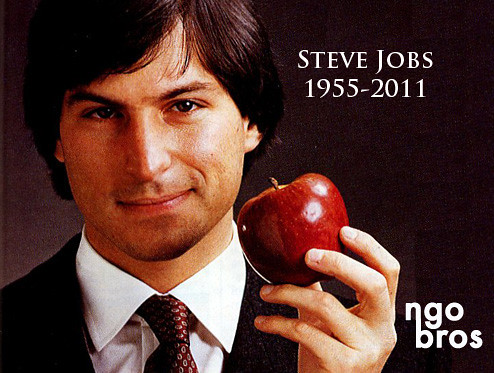
Losing Jobs Matters
The passing of Steve Jobs matters; technology will be less human than it could be.
Apple is one of the world's most influential organizations, not by sheer wealth, but by impact across variegated industries beyond technology: music, publishing, retail, and more.
Yet, as beautifully detailed by David Pogue Steve Jobs: Imitated, Never Duplicated, this influence was created and wielded by an iconoclast. Lots of companies are run by geniuses, but Jobs defined himself by running against the grain, doing things "wrong," and yet hewing to principle's of beauty that engendered cult status.
I can't imagine a board electing a CEO who, like Jobs, dropped out of college, never worked for anyone else, and simply didn't give a damn what other people thought.
So how did Jobs wind up running one of the world's top companies? It's because he built it, and he did so at the time of the industry's inception. Since the computer industry is long past its inception, we can be confident that it simply won't see another titanic iconoclast at the helm.
And this is a great loss.
Innovations will continue to pour out at an accelerating pace, but they will not cut to the soul as beautifully as those created in the world of Jobs. Simply put, Apple makes products that are, above all, powerfully human.
Is there another force on this planet as powerfully human-oriented than Apple? Oriented in practice, not simply ideology or disposition? I submit that the key was Jobs's deep, micro-managing, hands-on involvement in production, bringing the corporate might Apple to bear on the most minute impediments for common users to achieve their goals.
The entire might of one of the wealthiest companies was, for a time, directed at removing the impediments of common people from achieving their desires.
According to Pogue, there will not be another Steve Jobs, ever, and we are worse off for it.
Wednesday, October 5, 2011
How To Look Serious With Your Phone (5 Tips)
It happens daily. I'm faced with some serious work that can easily be handled with my phone, but I'm nervous to pull it out of my pocket. In the medical world in particular, the workplace is not a time for mobile frivolity, and skeptics abound.
Here are my five tips for looking serious when being serious with your phone.
1. Hold a pen in one hand. It just looks like you're working instead of chatting, I suspect it reminds onlookers of the Palm Pilots of yesteryear. I like to extend the pinky finger of the hand that's holding the pen. I'll occasionally draw attention to my pen by subtly tapping it against my forehead or pressing it against my temple, just to create the sell that I'm being serious here. If you're more adventurous, use another prop like a book- just holding it open can look like you're cross-referencing. Very serious.
2. Cradle with care. Hold the phone in your non-dominate hand, and tap at it with your dominate hand. If available, set the phone on a table. This looks like you're engaged in a task and either entering or manipulating content, rather than just consuming it. Even when I'm typing into a text field, I hunt-and-peck with one finger so that it doesn't look like I'm texting.
3. Don't hunch. Don't be caught cradling the phone in both hands, elbows bent, hunched over the screen like you're texting or trying to view someone's profile picture. If the phone is at a distance, it looks like you are open to sharing its content with others around you, creating the semblance that you are accessing professional material.
4. Share your screen. As often as possible, engage others around you in the content you are consuming. This helps establish you as a serious user because others can see that you're not fooling around. Additionally, it promotes the idea that a phone can have serious uses. Furthermore, even if you aren't shutting people out while engrossed in your phone, it's polite not to LOOK like you're shutting others out. However, be careful not to be that guy who is gleefully showing everyone how irrelevant they all are thanks to your snappy apps. (Even if you think it's true.)
5. Adopt a pensive look. This seems trivial, but really, who texts or scans Facebook with a knit brow and protruding lips? If the app is making you think, look like you are thinking (even if you're not).
Any other tips out there?
Tuesday, October 4, 2011
Disruption in the Doctor's Office
Traditionally, new technologies reached medicine in a top-down direction. The invention of MRI, for example, was first introduced to hospital administrators and department chairs as a potential new diagnostic tool. Once accepted, others further down in the medical hierarchy gained exposure.
This technology wasn't disruptive because it didn't change the overall structure of the field. As before, patients still came to hospitals for sophisticated diagnostic work-ups, only now the hospital had a better, albeit more expensive, tool.
Many of today's medical technologies are disruptive, which is different.
Take, for example, the iPhone app Skin of Mine. Take a picture of a suspicious mole and get either automated analysis about its likelihood of melanoma, or an online consultation with a dermatologist.
This invention is entirely unlike the MRI scenario. Instead of entering the field from the top down, it comes from the bottom up. Patients can walk into their doctor's office with this invention already in their pocket, asking questions about a diagnosis made by their free mobile app, all without the department chair or hospital administration even knowing of its existence.
This changes the overall structure of the field: the patient has direct and cheap access to diagnostics, less need for an office visit, and more information in the patient's hands.
A crucial question for medice is how to respond to disruptive changes that come from the bottom up? My guess is that most clinicians, understandably, will not take kindly to innovations that reorganize their workflow. The nightmare of adopting a new EMR is trivial compared to the challenge of restructuring how and where a doctor sees patients. Nonetheless, I'm guessing this change will be inevitable as patients clamber for the cheap convenience of such disruptive technologies.
Personally, I think medical schools hold the key to ushering this bottom-up transformation. They can serve as the field-testing ground for disruptive innovations, training the near-future doctors as well as offering exposure to their more entrenched clinicians, but in a structured way that blunts the stress of disruption.
Saturday, September 24, 2011
Three trends on the future of the medical profession, with links.
Ruminations on a profession:
Kent Bottles (@kentbottles) has a great piece:The Effect of the Information Revolution on American Medical Schools. It's a bit dated, but his opening comments on the nature of the medical professoin are golden.
Trend 1: Explosion of information tech and its consequences for medicine.
A GREAT 18 minute TEDtalk by Daniel Kraft: Medicine's Future? There's an app for that. (It's about leveraging cross-disciplinary, exponentially growing, technologies.)
Another fascinating TEDTalk by Eric Topol: The Wireless Future of Medicine. Many of these topics are covered in the Kraft talk, but it offers a wider survey of the gadgets.
Trend 2: Disruptive innovate is coming.
The bible on this topic is The Innovator's Prescription by Clayton Christensen and others. Disruptive Innovation in Health Care Delivery provides a synopsis of the major concepts. (This one might be a little painful- hang in there through the business model talk- t's worth it.)
Trend 3: Social Media is coming.
Clay Shirky is the guru of social media (a philosopher and a sociologist). He has two TEDTalks, the first is about group formation and action. It's from 2005 and not specifically about healthcare, but it doesn't take a lot of imagination to apply it to healthcare. The second is more about information streams, and the same goes. Specifically, he details the power of groups to usurp professionals.
If you have the time, Shirky's newest book Here Comes Everybody is a great, great read.
Of course, feel free to explore your own topics and content- these are just some suggested guidelines.
I'm excited for this session! Of course, let me know if you have questions.
Until then,
-Aaron
Subscribe to:
Posts (Atom)


